
The Health~Holland MKB Call is one of the Netherlands’ key funding opportunities for innovative Dutch SMEs in the life sciences & health sector. Unlike many larger national and European programmes, the MKB Call puts the SME firmly in the lead, focussing on industrial research rather than fundamental or academic research. The programme supports collaborative industrial research projects (TRL 4–6) between SMEs and research organisations, helping companies develop new healthcare solutions while strengthening their innovation capacity.
Below are six recommendations that consistently strengthen MKB Call applications.
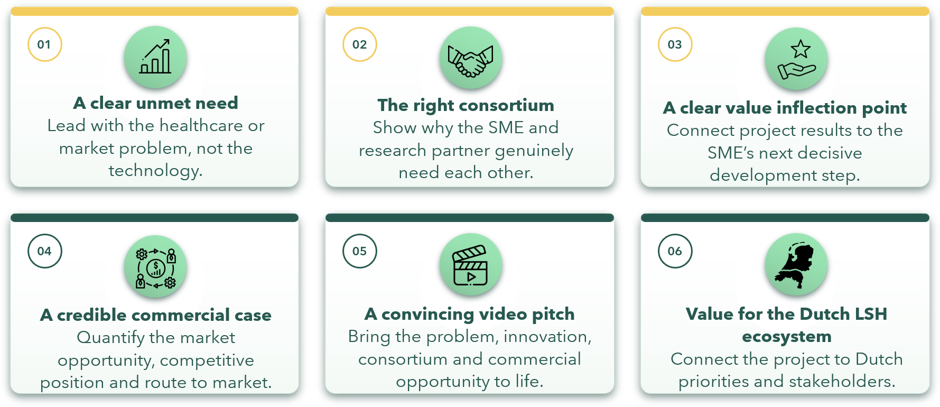
1. Demonstrate a clear market need before introducing your solution
Most proposals spend too much time describing the technology and too little explaining the problem it addresses. Instead, start by defining the unmet healthcare need and the limitations of existing solutions. Only then introduce your innovation and explain how it offers a meaningful improvement.
While generally good advice, this order is particularly important in the MKB Call, where reviewers explicitly assess whether the project addresses a societal need and whether the proposed innovation represents a meaningful improvement over existing solutions. The strongest proposals make it immediately clear that the project is driven by a real clinical or market demand, rather than by technological curiosity alone.
2. Explain why your consortium is essential for project success
A consortium should be more than a collection of partners. Each organisation should contribute expertise that is genuinely required to achieve the project’s objectives. Health~Holland expects effective collaboration: partners should work at joint cost and risk, contribute substantively to the project and bring complementary expertise. Explain not only what each partner will do, but why the SME could not achieve the same result alone and why the research organisation needs to be part of the project.
3. Make the next value inflection point explicit
The MKB Call is not intended to fund solely R&D. Reviewers want to understand how the project success enables the SME and why executing the project is critical in their existing long-term development plans. Will the results enable a Series A round, a licensing deal, regulatory progression, a clinical study or another decisive development step?
Define the value inflection point clearly and connect it to concrete project deliverables. The stronger the link between technical results and business development, the easier it is for reviewers to understand why the project deserves funding now, and why funding the project at this stage creates value for the Dutch life sciences & health ecosystem.
4. Build a credible and quantified commercial case
The commercial potential needs to be more than a paragraph stating the market is large. The MKB Call explicitly evaluates economic impact, competition, the route to market, the commercial strategy and the financial outlook.
Quantify the opportunity where possible: market size, target customers, expected adoption, development costs, pricing assumptions, future revenues or licensing potential. Just as importantly, explain how the project changes the company’s competitive position. Identify (Dutch) stakeholders that would benefit from the project and describe the relationships you already have, or plan to establish, with them.
5. Start on time with preparing a competitive pitch
In the MKB application, the video pitch is part of the first selection phase and should therefore be treated as a core component of the application rather than an administrative extra. It needs to communicate the problem, innovation, commercial opportunity and value of the consortium quickly and convincingly.
Anticipate that making the pitch might take more time than you expect due to additional takes and editing. Keep in mind that the final message of the pitch script should be in line with the final version of the application, bringing the most important parts of your message to life in a video.
6. Show the project’s value to the Dutch life sciences & health ecosystem
The call is not intended simply to support Dutch SMEs in their individual development. Rather, it funds SME-led R&D projects that can strengthen the wider Dutch life sciences & health sector. Applicants must therefore demonstrate how their project contributes to the National Technology Strategy (Nationale Technologiestrategie), relevant Dutch growth markets and the Health & Care missions (Missies Gezondheid & Zorg).
For example, when thinking about your target market, think if your innovation can be launched in the Netherlands. When planning future clinical trials, think if you can perform a part of them in Dutch hospitals. Mention throughout the proposal which Dutch e.g. medical professionals, researchers, suppliers or customers would benefit from having your innovation on the market.
How FFUND Supports SME’s and applicants
At FFUND, we support SMEs throughout the entire application process: from refining the project concept and coordinating partners, to developing a persuasive proposal and ensuring compliance with all programme requirements. Our goal is not simply to submit an application, but to maximise its competitiveness.
Get in touch if you would like to discuss how we can support you in your MKB application!