
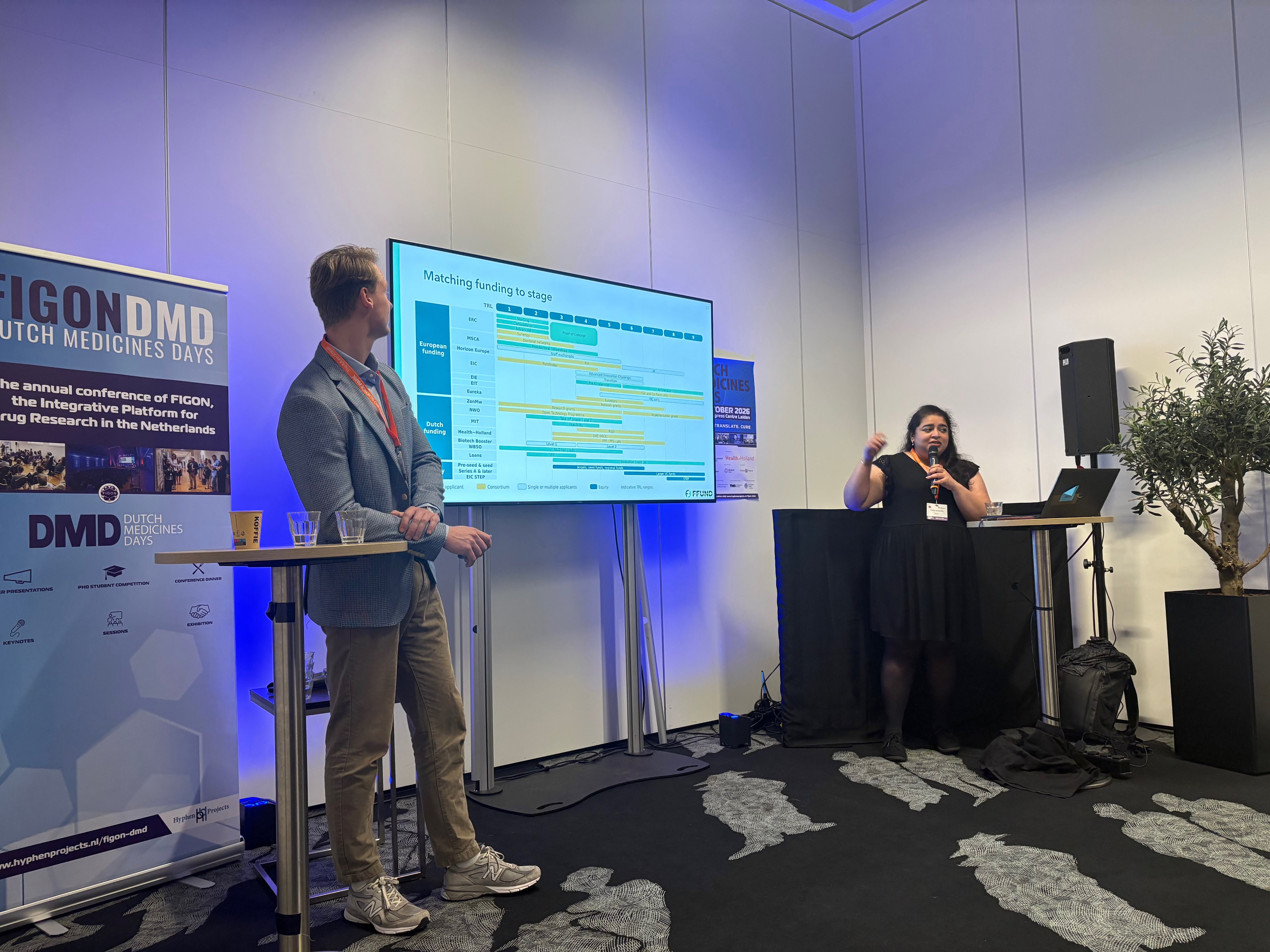
How does an early-stage life science innovation become funding-ready? t Dutch Medicines Days, on the 7th and 8th of October in Leiden, Harita Yedavally and Siebe Warnars hosted an interactive session on exactly that question, covering both non-dilutive funding (grants) and dilutive funding (investors).
Three questions for readiness
Grant evaluators and investors ask the same three questions. What do you know? What don’t you know yet? How will you find out? For early-stage life science innovations looking for funding, this is the basis they have to start from. However, what differs is the proof evaluators and investors need to see to answer these questions.
- A grant evaluator checks whether the project fits the call: excellent science, a realistic work plan and budget, and impact on public goals such as patient benefit or European priorities.
- An investor checks whether the company can grow in value: clean IP, a customer who will pay, and a credible route to a return, often a licensing deal or an acquisition.
For startups, this means telling the same next milestone from two perspectives: as a work plan for the evaluator, and as a use of proceeds for the investor. In both cases, startups need to show exactly what the funding enables them to achieve and how they will demonstrate success.
Key takeaways
During the session, participants got their takeaways through interactive exercises.
- They compared feedback from grant evaluators and investors, discovering that both look for similar fundamentals: a capable team, convincing evidence that the technology works and a credible plan for further development and commercialisation.
- They explored the trade-offs between grants, loans and equity investment, learning that the right funding option depends on more than the amount available. Important considerations include how much ownership founders are willing to give up, whether co-financing is required, what obligations come with the funding, and how long it takes before the money is in the bank.
- Participants mapped out their development milestone and the funding needed to reach it, then reviewed another participant’s plan from a funder’s perspective. The exercise highlighted the importance of connecting funding requests to concrete milestones and demonstrating how the funding will help the project move forward.
Our key message to participants and other startups: most rejections are a matching problem, not a quality problem. So, match the funding instrument to your next milestone, not the other way around.
See you next time!
To provide the best support and strategic advice possible, we make sure we stay up to date with the latest developments and innovations in the field. To do so, we regularly visit leading life science events, give workshops, and share our insights with you here.
