
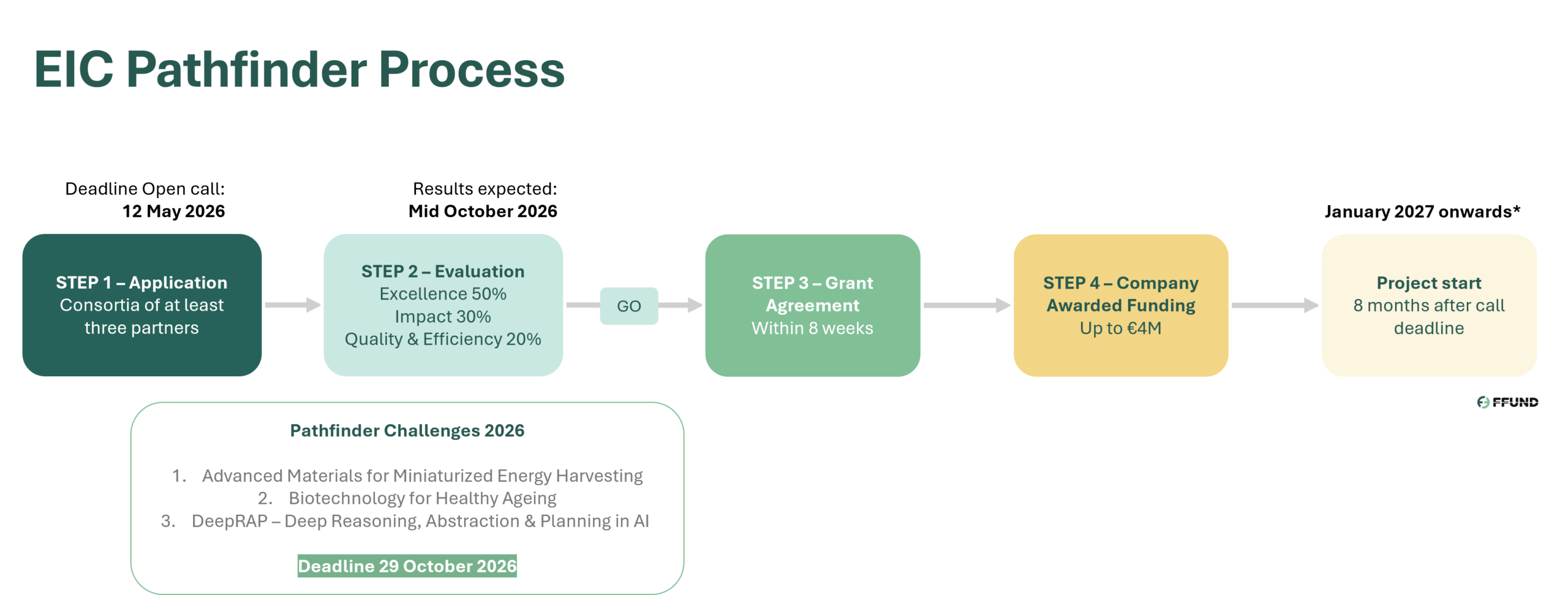
The EIC Pathfinder is the starting point of the European Innovation Council’s funding pipeline. The instrument is aimed at new scientific ideas that could become tomorrow’s breakthrough technologies.
Pathfinder projects aim to unlock new scientific foundations and early proofs of principle (TRL 1–4) that could shape future markets or disrupt existing ones. By funding ambitious interdisciplinary teams, the Pathfinder enables researchers to open new technological pathways that Europe can build on in later stages of the EIC funding continuum (Transition → Accelerator).
It is the instrument of choice for ideas that are too bold, too exploratory, or too unconventional to fit within traditional research schemes, but have innovative deep-tech potential nonetheless. EIC’s Pathfinder differentiates between Open (A) calls and calls for specific themes under Challenges (B).
Who can apply?
- Consortia only
- Minimum 3 independent entities from 3 different Member States/Associated Countries
Funding
- Up to €4M
- Lump sum, 100% grant
A. Pathfinder Open
Pathfinder Open welcomes innovative ideas in any field, giving applicants freedom to define the direction and scope of their breakthrough.
Deadline
- 12 May 2026
B. Pathfinder Challenges (2026)
Pathfinder Challenges invite proposals within specific themes where Europe aims to accelerate innovation. This provides a targeted route for teams whose ideas are closely aligned with an identified societal or technological need.
Deadline
- 28 October 2026
Challenge topics
1. Advanced materials for miniaturized energy harvesting
This challenge targets new classes of materials and material systems that can power miniaturized, autonomous devices, particularly sensors and IoT nodes, by harvesting energy from their environment. Projects are expected to explore materials that convert light, heat, motion, or electromagnetic signals into usable energy at very small scales, while reducing reliance on critical raw materials.
The end goal is the demonstration ofintegrated, miniaturized energy harvesters (TRL 4) that can enable battery-free or extended-lifetime devices for use in smart cities, agriculture, environmental monitoring, and industrial automation.
2. Biotechnology for healthy ageing
This challenge addresses the growing need for biological tools and interventions that promote healthy longevity. Proposals may fall into one of three categories:
- Interventions targeting hallmarks of ageing:
Development of therapies or biological strategies that modulate fundamental mechanisms of ageing, with proof-of-concept in vertebrate models to demonstrate functional impact. - Biomarker and screening tools:
Technologies enabling the identification, tracking, or stratification of ageing-related biological signatures, supporting personalized or preventative health approaches. - New Approach Methodologies (NAMs):
Alternatives to traditional animal models that can capture the systemic nature of ageing, such as organoids, microphysiological systems, computational models, or integrated multi-omics frameworks.
Proposals should also consider ethical, regulatory, and societal aspects, as ageing research moves toward real-world applicability.
3. DeepRAP: Deep Reasoning, Abstraction & Planning in AI
DeepRAP aims to push AI beyond pattern recognition towards cognitive-level abilities, including causal reasoning, abstraction, and long-term planning. The challenge seeks AI systems that can:
- build internal models of the world,
- generalize across tasks and contexts,
- reason about cause and effect,
- plan and adapt dynamically,
while ensuring high standards of trustworthiness, transparency, and alignment with EU values.
Projects are expected to deliver innovative approaches. For example, combining symbolic methods, world models, neuromorphic computing, or hybrid architectures, and demonstrate them in TRL 4 prototypes with robust evaluation benchmarks.
This article was co-created by:

Harita Yedavally PhD
Senior Consultant

Filipa Carvalhal Marques PhD
Senior Consultant

Isa van der Veen
Consultant