Your dataroom probably deserves more credit than it gets. Often, it’s a part of fundraising that gets neglected. But for investors, a good dataroom is essential. In this article, we tell you what investors look for in a dataroom and what you need to know to get yours in shape.
Behind every good deal is a good dataroom
Picture this: a founder, three weeks before closing a round, opens “the folder.” You know the one. It lives somewhere on a shared drive, has a name like “Investor Stuff_FINAL_v3,” and has been quietly ignored since the seed round. Inside: a pitch deck from 2024, a cap table that doesn’t add up, half a regulatory file, and seventeen versions of the same IP memo. The investor wants access tomorrow.
If this sounds familiar, you’re in good company. In the dataroom reviews FFUND runs for clients, the same handful of gaps come up almost every time. The dataroom is the part of fundraising that tends to get postponed the most. It rarely gets the same attention as your deck or your demo. But every investor will tell you: behind every good deal is a good dataroom.
Due diligence starts in the dataroom
A dataroom is, in essence, a structured reflection of everything you’ve built: your science, your IP position, your regulatory strategy and your financials. Investors don’t only use it to check whether your story is true. They use it to see whether the story holds up once they start asking questions.
A messy, incomplete, or contradictory dataroom raises more questions than it answers, and not the kind you want. For example, if investors find a cap table that does not match the latest financials, or an IP position that contradicts the pitch deck, they will start to question your company’s organisational quality. A sharp dataroom does the opposite. It builds trust before the first call even happens, and it lets due diligence run smoothly instead of resulting in months of follow-up emails.
Timing matters more than most founders expect. Start building your dataroom early on in the process, to have enough time to get it right and in the best possible quality. Assembling one early also forces you to track your own progress: if you cannot easily produce your latest IP status or an up-to-date financial overview, that is worth knowing long before an investor asks.
Less is more
Investors look for completeness, and that means striking a balance. A folder with thousands of files does not demonstrate thoroughness, it tends to demonstrate a lack of structure. At the same time, a dataroom that is too thin leaves investors guessing, which also rarely works in your favor.
The aim is precision: the right documents should be clearly organized in around 8-10 top-level folders and rarely more than two or three levels deep. Where possible, the focus of the dataroom should be tailored to the receiving investor. A specialist investor will want depth on the technology and the IP position. A more generalist investor may be more interested in a clear financial narrative and a credible route to market. Same dataroom, same company, slightly different emphasis depending on who will be looking.
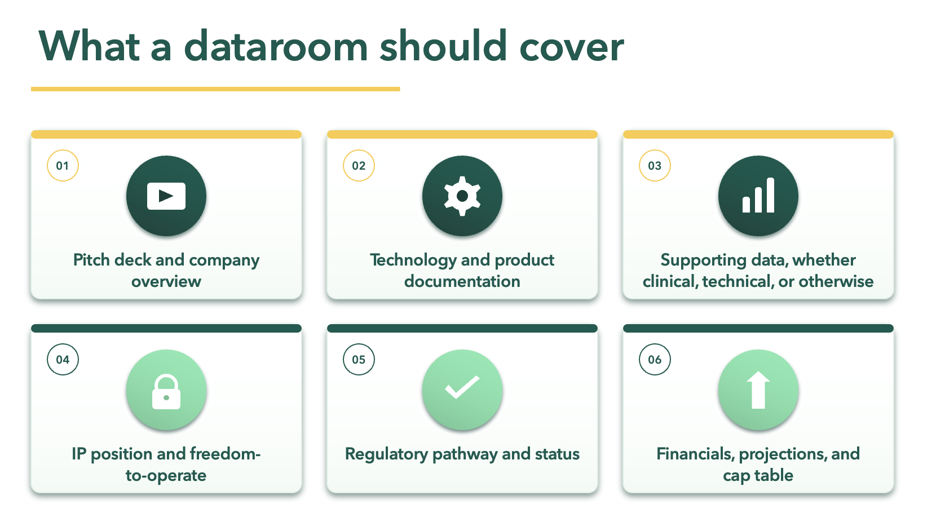
At minimum, a dataroom should cover the following items:
• Pitch deck and company overview
• Technology and product documentation
• Supporting data, whether clinical, technical, or otherwise
• IP proposition and freedom-to-operate
• Regulatory pathway and status
• Financials, projections, and cap table
How FFUND can help
We assess your dataroom the way an investor would: critically, and from the outside looking in. We tell you what is missing, what could be sharpened, and what should be tailored to specific investors. We also provide practical tips and support to improve it. This includes a clear structure to organize it properly, so that nothing essential is overlooked, and nothing irrelevant gets in the way. Looking for a critical review of your dataroom? Get in touch.