In life sciences, value is rarely defined by today’s revenue. Instead, it is shaped by tomorrow’s innovation development milestones, regulatory decisions and market adoption. Whether you are a biotech startup preparing for fundraising, a medtech scale-up considering strategic options, or an established company evaluating acquisitions, company valuation provides the framework that connects scientific innovation to commercial opportunity.
Life sciences companies operate in a high-risk, high-reward environment. Major value inflection points can occur with a single event: a successful Phase II readout, a regulatory fast track designation, breakthrough IP or early reimbursement traction.
In this landscape, a strong valuation framework brings rationale to uncertainty and helps stakeholders align on realistic outcomes. It informs critical decisions in:
- Fundraising and investor positioning
- Licensing and partnering negotiations
- M&A or strategic exit planning
- Portfolio prioritization and R&D allocation
- Scenario planning under clinical and regulatory uncertainty
When to get a valuation (and why timing matters)
Many leadership teams seek valuation support when they are already in the process of fundraising, or during partnering or M&A discussions. Yet, the strongest outcomes typically come when valuation is determined early enough to shape strategy, not only to justify it.
In the earliest stages of a company, valuation gives founders and investors a shared basis for discussing risk, upside, and milestones needed. It helps shape investment terms and informs key strategic choices, such as which indications to pursue first, how to structure the development path, and when partnership opportunities make sense.
As companies progress through development or early commercialization, valuation becomes increasingly important for capital raising, licensing discussions and strategic partnerships, helping in quantifying how upcoming milestones such as clinical data, regulatory submissions, or market expansion, translate into value creation.
At later stages, valuation becomes central to M&A discussions, strategic investments and potential exits. Here, valuation must integrate both financial performance and long-term growth potential, reflecting commercial scalability, pipeline expansion, and competitive positioning, as well as risks that could affect timelines and revenue potential.
How FFUND can help
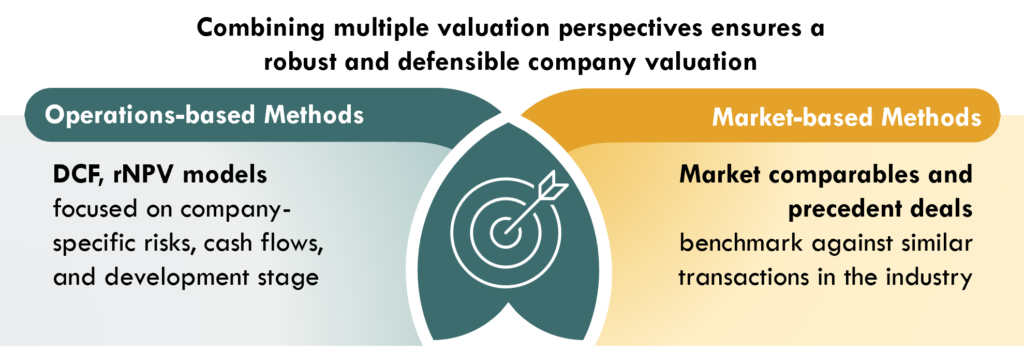
At FFUND, we support biotech, medtech and health innovation companies with robust, decision-grade valuation frameworks at all stages, supporting better decisions, stronger negotiations, and improved access to capital. Our approach combines deep industry understanding with rigorous financial analysis, drawing on a combination of methods including risk-adjusted net present value (rNPV) modeling, the venture capital method, and precedent transaction benchmarking to ensure valuations are both analytically sound and aligned with market realities.
Whether your goal is to raise capital, negotiate a partnership or define your strategic direction, FFUND can help you at any stage to move forward with a thorough and well-founded valuation.