
The EIC Accelerator supports high-risk, high-impact innovations developed by start-ups and SMEs. It is designed for companies that:
- Have a novel, breakthrough deep-tech solution
- Need substantial funding to reach market readiness and scale commercially
- Are developing technologies aligned with Europe’s strategic priorities and competitiveness
- Face financing barriers because the risk is too high for private investors alone
The Accelerator provides both grant funding to finalise development (TRL 5/6 → TRL 8) and equity investment to support scale-up activities (TRL 8 → market expansion).
Who can apply?
- SMEs and start-ups (established in an EU Member State or Associated Country)
- Spin-offs or small, high-tech companies
- Individuals or teams intending to found a start-up (must incorporate before signing the contract)
- Small mid-caps (499 employees or less) → eligible only for the equity investment component
Proposals must involve:
- A deep-technological innovation with strong IP or unique knowledge
- A solution requiring substantial development and scale-up financing
- Clear potential for international market creation or disruption
Funding possibilities
1. Grant (for innovation development)
- Up to €2.5 million
- 70% funding rate (30% co-financing)
- Supports activities such as prototyping, trials, certification, regulatory work, and demonstration
- Targets transition from TRL 5/6 to TRL 8
2. Equity investment (for scale-up)
- €1 million to €10 million (larger amounts possible in justified cases)
- Provided through the EIC Fund
- Supports:
- market entry
- manufacturing scale-up
- international expansion
- working capital
- strategic deployment
3. Blended finance
Combination of grant + equity in one application.
4. Grant-only or investment-only
Possible in specific, justified cases (e.g., companies that already reached TRL 6 and do not need grant support).
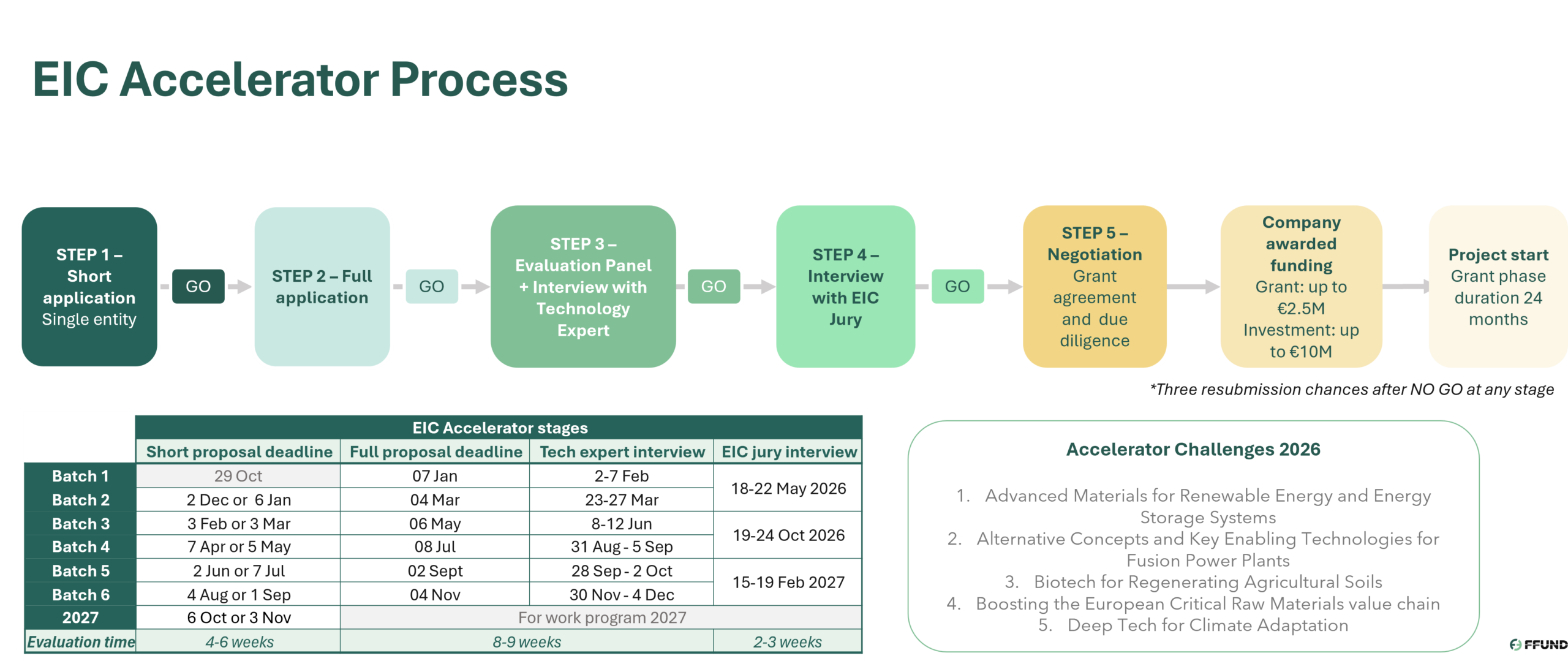
Deadlines (2026 cut-offs)
- 4 March
- 6 May
- 8 July
- 2 September
- 4 November
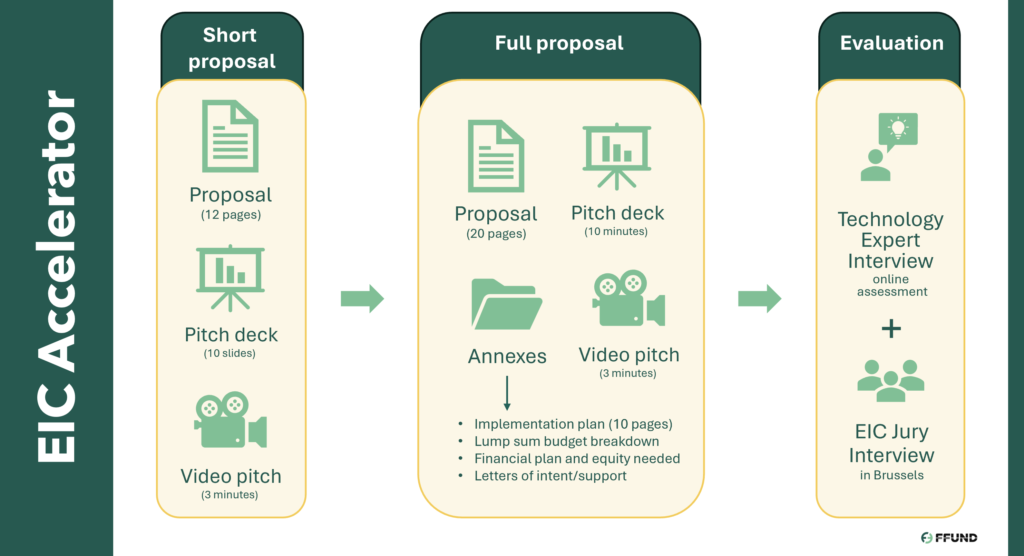
Challenge topics (2026)
1. Advanced materials for renewable energy
Supports innovative materials and material systems that improve performance, efficiency, durability, or sustainability of renewable energy technologies. This includes breakthroughs in photovoltaics, wind energy components, energy storage materials, hydrogen systems, or materials enabling next-generation clean energy production.
2. Fusion technologies
Targets enabling technologies needed to accelerate the development and industrialization of fusion energy. This covers advanced materials, superconducting systems, plasma control, high-performance components, diagnostics, and other technologies that can help Europe progress toward commercially viable fusion power.
3. Biotech for soil regeneration
Focuses on biotechnology solutions that can restore or enhance soil health, fertility, and biodiversity. This includes microbial or enzymatic technologies, bio-based amendments, monitoring tools, or biological processes that support sustainable agriculture and carbon sequestration.
4. Critical raw materials value chain
Supports innovations that reduce Europe’s dependence on critical raw materials through recycling, substitution, advanced processing, or improved resource efficiency. Projects may address extraction alternatives, circularity solutions, or breakthrough technologies that secure essential materials for EU industry.
5. Deep tech for climate adaptation
Targets deep-tech solutions that help society and infrastructure adapt to climate impacts. This may include advanced sensing systems, resilient materials, predictive modelling tools, water management technologies, or systems that support climate-resilient agriculture, cities, and ecosystems.
This article was co-created by:

Harita Yedavally PhD
Senior Consultant

Filipa Carvalhal Marques PhD
Senior Consultant

Isa van der Veen
Consultant