
The EIC Advanced Innovation Challenges are a new initiative designed to accelerate strategically important breakthrough technologies. Unlike traditional research calls, these Challenges take a mission-driven, user-focused approach, bringing innovators and end-users together from the very beginning.
The goal is simple:
- Identify bold, deep-tech solutions with transformative potential
- Rapidly test their feasibility and relevance
- Fast-track the most promising ones into real-world deployment
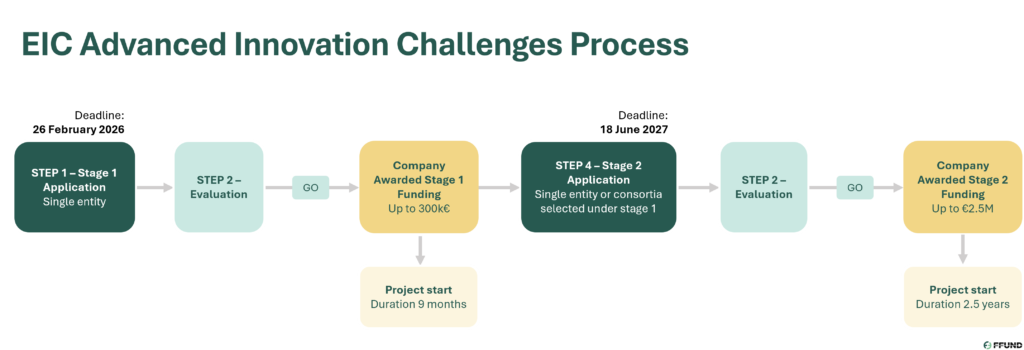
Through a two-stage process, the scheme first supports quick technical and market validation (Stage 1) and then expands into large-scale development and testing with users (Stage 2). This makes it ideal for technologies that could reshape entire sectors if given the right boost at the right time.
Who can apply (Stage 1)?
Single applicants only (no consortia in Stage 1):
- SMEs
- Start-ups
- Research organisations
Funding (Stage 1, 2026)
- €300,000 fixed lump sum
- Duration: 9 months
- Focus: solution feasibility, benchmarking and early user validation
- Includes mandatory user workshop
Themes for the Advanced Innovation Challenges
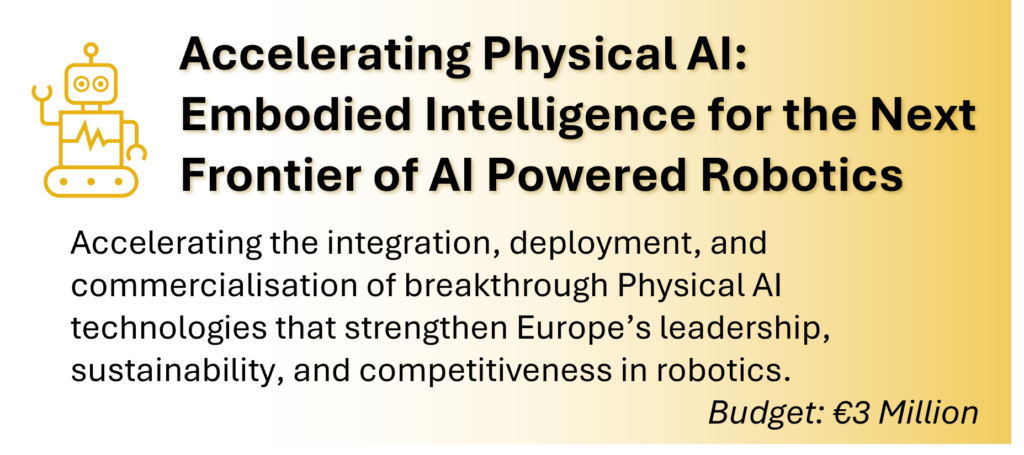
1. Physical AI for embodied robotics
This challenge targets the next generation of robots that combine advanced AI with physical capability. The focus is on concepts that enable robots to perceive, learn, reason, and act more autonomously in real-world environments. Projects may explore new materials, sensing or actuation technologies, or AI approaches that support adaptive and safe interaction with people and surroundings. Stage 1 aims to validate feasibility and benchmark early results with user input.
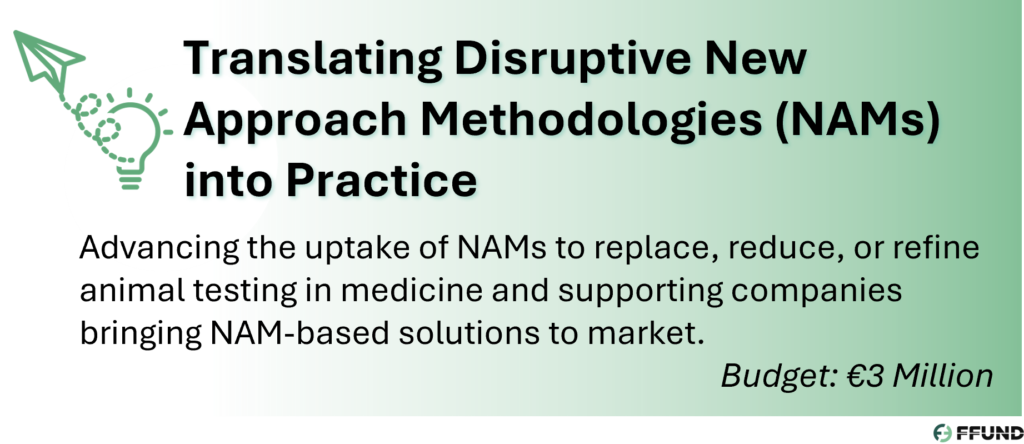
2. Translating New Approach Methodologies (NAMs) into practice
This challenge supports the advancement and real-world adoption of non-animal testing methods for assessing safety and efficacy. Projects should demonstrate NAMs that are reliable, scalable, and usable by regulators or industry. This includes developing protocols, reference data, or tools that link NAM outcomes to human-relevant assessments. Stage 1 focuses on demonstrating feasibility and relevance; Stage 2 will enable testing in operational settings.
Deadline Stage 1
- 26 February 2026
Deadline Stage 2 (planned 2027; further details provided in Work Programme 2027)
- Only Stage 1 winners can apply
- Up to €2.5 million, 2.5 years
- Allows small consortia (2–3 partners)
- Focus: real-world testing, integration, and deployment
This article was co-created by:

Harita Yedavally PhD
Senior Consultant

Filipa Carvalhal Marques PhD
Senior Consultant

Isa van der Veen
Consultant